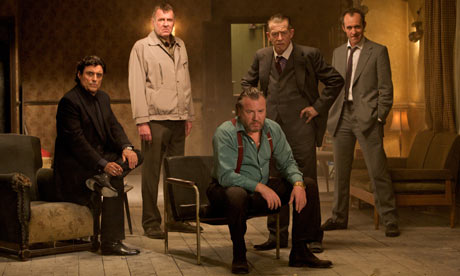
 Looking at 44 Inch Chest from the outside it seems to be a film with a lot to offer and the right cast to offer it. Look at the cast: Ray Winstone, Ian McShane, Tom Wilkinson, John Hurt.Come on, this thing has to be good, but what 44 Inch Chest represents is a reason why we can not bank on the names on the poster or the cover. What you get is a hodge podge mixture of Glengarry Glen-Ross and Reservoir Dogs that is the cinematic equivalent to chocolate and ketchup mixed together.
The plot follows Colin (Winstone) who is a blubbering mess, going over the edge after his wife tells him that it's over. His four friends, in an attempt to save their friend, decide to kidnap Colin's wife's lover and allow Colin to get his revenge and kill him. The film is basically set in a run down tenement with the characters bantering in guy speak while Colin contemplates how he's going finish the evening.
This is a film with great acting and great actors. The problem is that the story is weak, no matter how well you act it out. When you go into 44 Inch Chest you expect a great ensemble cast with some very memorable moments between some of the greatest British actors of our time and you do get that when they're allowed to interact on screen and it's great, particularly the exchanges between McShane's homosexual character and Hurt's homophobic old man. The films problems, just like it's sister film Sexy Beast, occur in that third act. You see, we're privy to the Winstone character sniveling through most of the film at this point and when he's left alone in the room with the "Loverboy" it further perpetuates the pathetic existence that Colin has fallen to in his break up. Hey! We get it! Winstone, though a great actor, gets way too much screen time with this performance. Sure, I know he's upset, but a normal person would at least make some effort to bullshit me into believing that they are a little okay. Colin's constant crying is like being beaten with a hammer by the third act and we start to not care.
I have to compare this film with Glen Garry Glen Ross. It's a group of great actors in close quarters spilling their guts on the screen. The big difference is that with the earlier film, by the end, I actually gave a damn about Jack Lemmon desperately trying to hold onto his job. I thought that Al Pacino should have won the Caddy. By the end of 44 Inch Chest I just want Winstone to either shoot the bastard or go home. I was tired with the character. That's the sad part about this film. There was so much potential and it worked, but crumbled under a script that tried to go a little too far. Death by excess.
 Everyone's favorite maintenance man returns (sort of) to ruin the night emissions of any teenagers with an Elm Street address in this update of Wes Craven's 1984 masterpiece. The film examines the interrupted sleep patterns caused by a mysterious man of their dreams named Freddy Krueger (Jack Earle Haley), a horribly burned spectre sporting a glove fitted with razor blades on the fingers. One by one each victim is picked off by Freddy in the dream world
.
We now live in a world where what is old is new again. Sometimes it's great (Star Trek, Casino Royale). Sometimes it's acceptable (Texas Chainsaw Massacre). Sometimes it's horrible (Halloween). Michael Bay and Platinum Dunes has become the Ray Kroc of remerchandising dead horror franchises for a new generation. Nightmare on Elm Street represents the last of the "Big Three" to be re-cast, redesigned, and re-tooled for the next generation. The problem is that they're not very good. Not that some of the originals were that good in the first place, but they had this kind of feel to them. They were fun cheese. And when the era died out they tended to die out with it.
The Nightmare remake takes into account the film that created it's built in audience. There's the blond flying around the room being ripped to pieces, then appearing in the body bag. There's the Stay Puft floor, made bigger and better with CGI. There's the new and improved make up that makes Krueger scarier than Robert Englund's performance.
The problem with A Nightmare on Elm Street is that it's basically a paint by numbers film. You know when a scare is going to happen and how it's going to go down. It also eliminates the Bogeyman vibe that the original film had by giving the audience a nice flashback to show just what happened. In 1984 we heard a nice short story about Krueger being a child killer that got torched with the help of John Saxon. That's it. You learn a little bit, but he's still and shadow in your mind at night. He's everyone's nightmare man. Of course the sequels ruined this, but going original to re-make there's that lost fear. The Halloween remake also failed on this point, making both films to go from making you fear what lurks in the night to watching a snuff film. We don't care because these psycho's aren't coming after us. We're all cool.
One of the issues that have come up with this film is that it's a new direction for the Krueger character. Gone is the funny man. This time he's sadistic and serious. The thing is that going back to the original film (and its sequel) the character was a sadistic bastard. Sure, the sequels had him coming out of a TV, being in a comic book, and riding a skateboard. The first two films featured a sadistic villain with Englund giving his portrayal a hint of sarcasm. He was a true psycho. Our new version sounds like a heavy breather with no sense of purpose. It's like a character spinning his wheels.
With a script that pays homage to the original and little else, Nightmare is another tick on the re-make headboard, but was there a need for it? Can't we come up with new bogeymen to replace the old ones? Hell, why should we? These films have a built in audience which translates to built in $$ that equates to not mattering if the movie is good or not- the fans will show up. The days of originality in horror are dead. It's just the bogeymen that keep coming back.

There are many phrases that can be used for Pink Floyd The Wall. An orgy for the senses. A total mind f*&k. A piece of shit. It's one of those movies that you either love or hate. There's no middle ground to this movie.
The film is about rock star Pink (Bob Geldof) who is slowly falling to pieces in his hotel room on the sunset strip. This is before the world was ingesting happy pills to eliminate or horrible pasts, so Pink is doing what was done in the era- sitting around watching TV with groupies. As the film progresses we see the things that pushed Pink to the precipice- the father he never knew dying in a war he didn't understand. The education system that was an assembly line for "citizens". The overbearing mother. The promiscuous wife. These things serves as his "bricks", layering upon each other until he really is behind his wall. Pink will be vulnerable no more. But at what cost?
The Wall is one of those films that breaks conventions, especially when thinking about musician movies. The norm is for the actual band to appear in their own film, but that's not the case with The Wall (though concert footage was going to be intertwined, but that's another story). This is a visualization of Pink Floyd's album from three years earlier. The fact that the band doesn't appear and most of the cast are relative unknowns shatters the idea of the rock star movie, most of which were either corny or bad (A Hard Day's Night is the logical exception).
Alan Parker's haunting visuals give us the starkness of Pink's outside world. It's a world of dark hotel rooms, fascist parades, and a general malaise from the title character. What really allows us to get inside Pink's head is the animations by Gerald Scarfe. You know you have a good design when kids are wearing them on t-shirts thirty years later. One of the most striking pieces in the film is the one I like to call the Georgia O'Keefe sequence where two flowers court each other, make love in a swirling vortex of Freudian images where you see the act, yet you don't and finally ending with the female plant consuming the male counterpart. This is Pink's psychosis as he continues to build his Wall. This isn't the Incredible Mr. Lippett.
The reason The Wall has continued to be relevant in an ever changing society is that it's issues go straight back to that age old rock n' roll ingredient called teen angst. Parents are lost to death or divorce as they also can be hindrances, schools want you in the classroom to meet a quota and get their government check, and who can forget those good old teen age relationships that really weren't as monumental as they were at the time. Every generation goes through this same stuff, making it relevant over and over again. This film has become a right of passage. Somewhere right now a teenager or a whole group of them is watching this for the first time. There won't be an analytical discussion of what the movie was about or Pink's little mental glitch, but it will stick with whoever watches it. I expect the day will come shortly when my copy is missing from the shelf, along with Manos: The Hands of Fate.
 I'm going to give you the plot- Gerard Butler is a bounty hunter. Jennifer Aniston is his ex-wife, who has also skipped bail. He owes loan sharks money. She's a reporter that may have stumbled on a story concerning crooked cops. Now, if you've seen a decent amount of movies over the last twenty years you know what's going to happen in this film.
The Bounty Hunter pulls so many cliches that every other Hollywood film this years is going to have to be original since this one used everything in the cabinet up. Yeah, they hate each other now. But wait til they get shot at. It's Love American Style! Sure, we've seen it before, but never in such a convoluted mess like this one. The plot is as weak as Keith Richard's bicep. Of course director Andy Tennant (whose entire career is this same movie over and over again) compensates by giving us five minutes of Aniston's ass to start the film and Butler's McConaughey Scene. Sorry, it's still crap. We've seen it all before in much better versions.
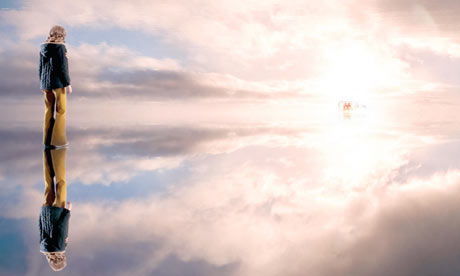 Undeniably a different approach to a story, The Lovely Bones is about a Susie Salmon (Saoirse Ronan), your typical 1970's teenager with David Cassidy on her walls and a Babarino-esque boy on her mind. The movie opens happily enough, with her finally getting asked out by THE boy. Life is good. Until she is murdered on her way home from school. At this point the film falls into a pit of despair as Susie watches from what I can't really call heaven and I can't call it purgatory. As much as she seems to enjoy her new found dimension I guess, for the sake of me looking up the exact term, we'll call it Disney of the Dead. As I said, Susie is watching from Disney for the Dead as he parents (Mark Wahlberg and Rachel Weisz) grieve in their own way and her murderer (Stanley Tucci) sits, waiting for the demon in his soul show up again.One of the tings you'll notice about The Lovely Bones is that the acting is great. There's emotion on the screen without the film becoming a sob fest. Everyone does a great job and it shows. There are really two main problems with the film that drag it down from a good movie to the level of average/mediocre. The first problem is some of the story elements. There are times in this film where you'll think to yourself "People wouldn't act this way" even in the face of the disappearance and murder of a child. Believability suffers in this case. The second problem is the entire idea of Disney of the Dead. The reason I gave it that name is because this is apparently the happiest place off earth. Sure, Susie watches her family go through hell, but at least there's a nice cut away of playing in this place that can be anything, right along with yourself. Hell, sign me up to be murdered by Stanley Tucci if the afterlife is this good! Unfortunately, the Disney of the Dead scenes take away from the film tremendously. There's one point where Susie meets her murderer's other victims. It's supposed to be a poignant scene of a group of people that share a common bound in that their lives were cut short. Sadly, director Peter Jackson, who is obviously used to directing CGI creatures gives us a sequence that is the equivalent of a Tampax commercial. Derailed.But that's essentially what The Lovely Bones is- Peter Jackson showing us that he can do more than long winded CGI films about elfs and Greg Allman. To give him credit, the scenes that don't occur in Disney of the Dead are well directed, though there are a few shots that make you think a second rate Scorsese was behind the camera. It's those damn CGI filled fun fests that take away from the film instead of adding to it. What this really amounts to is a failed experiment for Jackson. Time to go back to the well (The Hobbit).
 Sexy Beast is about a retired bank robber named Gal (Ray Winstone) who is asked to return to the UK and help with another job. Asked isn't quite the correct term. Persuaded perhaps? No. How about bludgeoned psychologically into returning to his old profession. An old acquaintance named Don (Ben Kinglsey) comes to Gal's Spanish home and proceeds to verbally abuse everyone in the general area, wired beyond belief. Don can not shut up and everything out of his mouth is exactly what everyone doesn't want to hear. Sent by his boss (Ian McShane) Don will not take no for an answer. Hell, Don won't shut the hell up long enough to listen to anyone tell him no.
Sexy Beast is an entertaining crime drama, pseudo comedy. It had an interesting plot that is a bit interesting. Nothing monumental, just interesting. The problem with the film is Ben Kingsley's performance. No, I haven't gone nutty and decided to bash one if his best roles. He's great as Don Logan. The problem is he's too great. Way to great in the role and it's this greatness that changes the third act from typical resolution of the problem into a long meandering path because we're sitting there marveling at the Kingsley role (which is relatively short lived in the film). There's no real pay off to end the film with- it's in the middle.
Besides Kingsley, Winstone turns in a good performance and you'll forget McShane is even in the thing. What Sexy Beast represents is a film that would have been buried long ago had it not been for Ben Kingsley going bat shit on screen. He's the pulse of the film and when he's removed it dies on the table.
 There's a line in Crazy Heart where Jean (Maggie Gyllenhaal) asks Bad Blake (Jeff Bridges) who is "real" country with Bad only listing his protege who has had to adapt to the changing times and watering down of country music to survive in a recording industry ran by suits. Not that country music is the only genre that's being hit with an identity problem. Look at rock n' roll. Now let's be honest with ourselves- does anyone see an album from the last fifteen years that even comes close to being a Led Zeppelin IV, an Abbey Road, a Dark Side of the Moon, or a Sticky Fingers?
I grew up in a household that thrived on Conway Twitty (sleazy bedroom music), Lorretta Lynn, George Jones, and Johnny Cash. What does Jean mean when she says "real country"? My answer is do you see Johnny Cash having his own brand of cologne and being a GQ model? Didn't think so.
That's what Bad Blake represents. He's the last of the old guard, a performer that thrives on hits two decades gone and the fans that still come out to see him. He's the last stereotypical country star, driving to gigs in a 1978 Suburban and getting drunk on stage. That's real country.
Crazy Heart follows the basic structure of The Wrestler with Bridges delivering a performance that is beyond belief. He is immersed in the role of Bad, letting us forget that he was The Dude. He's the rug that pulls the film together. If for no other reason in the world, see this film for Bridges' performance.
The problem with following The Wrestler storyline is that you get the feeling that you've seen it all before and it becomes a bit cliched. There's the disinterested love interest. The long, lost child. The one chance for the comeback. it's all in there, but as I said- even if the story is a bit so-so Jeff Bridges molds the film into something much, much more than it would have been otherwise.
So I guess what I'm saying is that "real country" is a drunken, puking, dirty old guy driving to gigs in a 1978 Suburban. Of course you're going to get better tunes from the guy drinking whiskey in a Suburban than a prima dona drinking Perrier on a tour bus.
